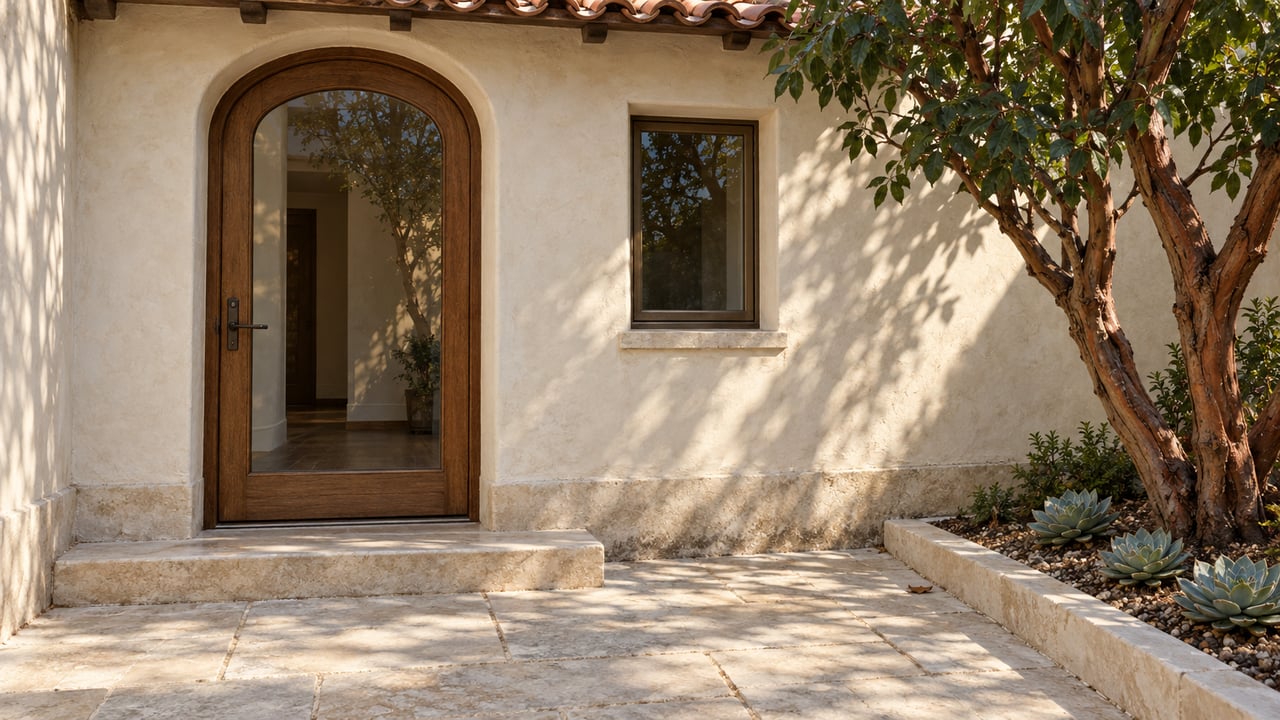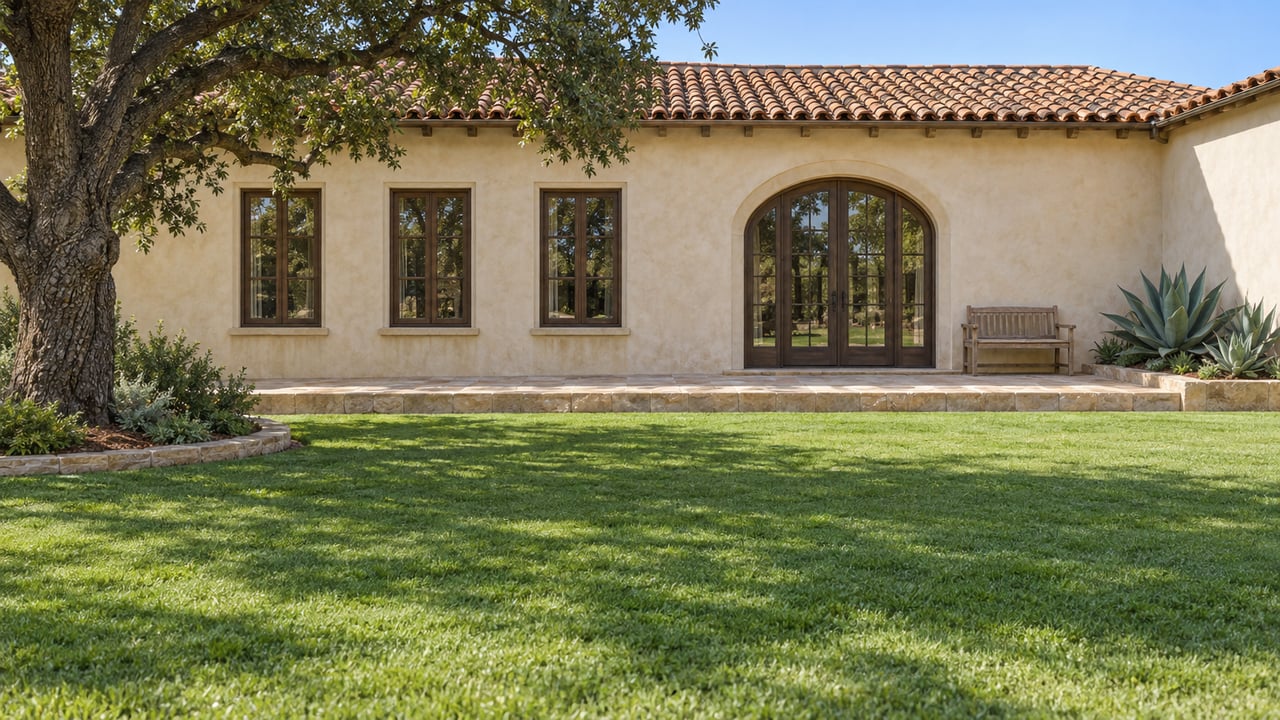
About 70% of Montecito Water District's costs are fixed. The flat monthly meter charge on every bill recovers only about 26.5% of those fixed costs, according to the district's adopted FY2027 budget. The rest is collected through tiered usage rates. In Montecito, the district estimates that about 80% of residential water goes to landscape irrigation. On a large lot, then, the lawns, hedges and orchard pay much of the cost of supply contracts the district owes in wet years and dry ones. That includes a State Water Project contract it has not used to meet customer demand since 2019.
For a buyer, this changes what the water line in an ownership budget actually is. The total still rises and falls with the weather, but a large part of each bill pays for fixed obligations. How much of those obligations a property carries depends on two things: the size of its meter and how much land it irrigates.
The meter is the first number to check
The Montecito Water District rate schedule sets a monthly meter charge that every active connection pays, whether or not it uses any water. Rates took effect July 1, 2026, and the next scheduled step takes effect July 1, 2027.
| Meter size | Monthly charge from July 1, 2026 | Scheduled from July 1, 2027 |
|---|---|---|
| 3/4-inch | $71.46 | $75.57 |
| 1-inch | $117.21 | $123.95 |
| 1 1/2-inch | $206.71 | $218.60 |
| 2-inch | $326.06 | $344.81 |
| 3-inch | $1,121.71 | $1,186.21 |
| 4-inch | $2,195.82 | $2,322.08 |
| 6-inch | $4,980.54 | $5,266.93 |
About 83% of district connections use 3/4-inch or 1-inch meters. Many estate properties have larger ones. A 2-inch meter costs $326.06 a month before any water is used, and a 4-inch meter costs $2,195.82.
Changing meter size after closing has its own cost. Under the connection-fee schedule effective July 1, 2026, a meter size change is billed at time and materials, plus the full new-tap connection fee and the difference in capital-cost fees. For comparison, a new 3/4-inch connection runs $35,453 in combined connection and capital-cost-recovery fees, and a new 2-inch connection runs $134,282. Those figures show why the meter already serving a property matters during due diligence. Upsizing later is priced like a new connection.
The tiers do most of the work
Once the meter charge is paid, single-family residential usage is billed in three tiers per hundred cubic feet, or HCF. From July 1, 2026, Tier 1 covers 0 to 9 HCF at $6.83, Tier 2 covers 10 to 35 HCF at $14.56, and Tier 3 covers 36 HCF and above at $17.21.
Here is a worked example using those published rates. A property on a 2-inch meter that uses 60 HCF in a month would pay $61.47 for the first 9 units, $378.56 for the next 26 and $430.25 for the last 25. Add the $326.06 meter charge and the month comes to about $1,196, before any other charges. More than two-thirds of that comes from usage, and almost half of the usage charge comes from the top tier.
Seasonal swings make this bigger. The district reports that monthly use can vary by about five times between summer and winter, mainly because of irrigation. Tier 3 makes up a much larger share of a summer bill on a landscaped acre than of a winter one. Since meter charges cover only about a quarter of fixed costs, the high summer tiers carry much of the district's fixed cost recovery. The district projects that the fixed monthly meter charge will bring in about 24% of total operating revenue in FY2027.
The fixed costs those tiers are covering
The FY2027 budget lists water purchases as the district's largest operating expense, budgeted at $15.2 million, up 9% from the prior year. The budget attributes the increase mainly to State Water Project charges and desalination operations and maintenance. Total operating expenditures for FY2027 are $27.1 million.
Two contracts make up most of that. The first is the 50-Year Water Supply Agreement with the City of Santa Barbara. Since 2022 it has added about 1,400 acre-feet a year, a steady amount that does not depend on rainfall. The district's 2024 rate study projected $7,747,457 for that agreement in FY2027.
The second is the State Water Project. The same rate study projected $4,608,342 in State Water costs for FY2027. According to the district's September 29, 2026 board packet, participants must pay their full share of capital and operating costs every year "regardless of whether the state delivers a 100% or 0% allocation." The packet puts Montecito's cost at nearly $5 million a year and says those costs are projected to rise. Allocations have averaged 46% of contracted amounts over the past decade and fell to 5% in 2021 and 2022. The Montecito Journal reported that the district has not used State Water to meet customer demand since 2019.
The district has found some use for that surplus. Under a June 2024 agreement with Homer LLC, it plans to sell 900 acre-feet of its 2026 State Water allocation at $634.92 per acre-foot during FY2027. The fixed charge itself stays in place.
What the Solstra letter changes, and on what timeline
On September 29, 2026, the district's board approved a non-binding letter of intent to sell part of its State Water contract interests to Solstra Communities California LLC. Solstra is the developer of Solomon Hills, a planned project of 4,000 dwelling units south of Santa Maria near Orcutt. Noozhawk described the vote as a first step toward a sale.
The board packet lists these key terms:
- 1,400 acre-feet of State Water contract interests, about 42.4% of the district's total.
- 550 shares in the Semitropic Groundwater Banking Program, plus 1,650 acre-feet already stored there.
- An upfront price of $36.5 million, escalating monthly with CPI until closing, estimated at $40 million in 2028.
- $1.8 million in annual operations and maintenance costs transferred permanently to the buyer.
- A purchase and sale agreement within 180 days of the letter's execution, with financial closing tied to final approval of Solomon Hills.
The district would keep about 1,900 acre-feet of annual State Water allocation. Board President Brian Goebel explained his vote to the Montecito Journal: "We'll be way better off if we diversify by ridding ourselves of a part of the State Water Project that we do not need."
The proposed uses for the proceeds and savings are local, rainfall-independent supplies, infrastructure, reserves, debt reduction, and "mitigating future water rate increases." The district has not decided how the money will be used. The Montecito Journal reported that even with a signed purchase agreement, the sale would not be final until Solomon Hills receives all of its approvals, which "could take several years."
In the meantime, the rate schedule continues. Resolution No. 2286, adopted June 25, 2024 after a Proposition 218 process, set a 9% increase for FY2025 and 5.75% a year after that through FY2029. The July 1, 2026 increase was the third of the five. For anyone buying this winter, the next published number is the July 1, 2027 step shown in the table above.
The water budget printed on every bill
Since April 2025, each Montecito Water District bill has shown a property-specific monthly water budget. The district describes it as a target for efficient indoor and outdoor use that adjusts for seasonal irrigation while preserving existing landscaping. Taken together, customer budgets total 4,334 acre-feet a year. Actual use of 4,325 acre-feet stayed within that total.
Today the budget is a guide, and the district's shortage plan explains when that would change. At Shortage Levels 1 and 2, the plan calls for communication and targeted outreach to customers who exceed their budgets. Starting at Level 3, it lists a drought factor applied to budgets to reduce outdoor irrigation, a penalty for use above budget, and a ban on refilling pools, spas and ponds, with topping off still permitted. The October 27, 2026 board packet projects a three-year outlook with enough supply to meet planned customer use and no expected shortages or need for imported water.
A seller's recent bills show how the property's actual use compares with its budget, which can tell a buyer more than any single month's total.
How this sits against the price of entry
The Santa Barbara Association of REALTORS® September 2026 summary shows a year-to-date median of $5.775 million for Montecito houses and PUDs through September, with 2.9 months of inventory. The same summary shows $2.055 million for Santa Barbara and $2.2 million for Carpinteria/Summerland. At Montecito prices, the water bill is a small share of the cost of owning a home. It recurs every month, it grows with the size of the garden, and its fixed portion rests on contracts the community will keep paying for years whatever happens to the Solstra transaction.
FAQ
Will the State Water sale lower my bill? Not for now. The sale depends on Solomon Hills receiving its approvals. Lower future rate increases are listed as one possible use of the proceeds, but the board has not decided how the money will be used.
Does an orchard on the lot mean agricultural rates? Not automatically. The district's 2024 rate study treats Agriculture as a separate class. Agricultural supply is interruptible and excluded from the City agreement costs. The district reports about 44 agricultural accounts and many residential properties with small agricultural areas.
Are there water charges on the property tax bill? Yes. The Water Availability Charge is $30 a year per acre, or per parcel if the parcel is under an acre. It is collected with property taxes and used only for water system improvements. Sewer service from the Montecito Sanitary District is also billed through the tax roll. Noozhawk reported that from July 1, 2026, the charge for a single-family home is $1,650.93 a year, up from $1,480.
This post is general information, not legal, tax or financial advice. Please confirm the charges and terms for a specific property with the district and with your own advisors.
When we represent buyers in Montecito, the water account is part of due diligence: the meter size, a full year of bills, and how the property's use compares with its budget. To review those numbers for a property you're considering, contact Locale Group to request a confidential consultation.